Why Are AAAStand Tensioner Pulleys Ideal for High-Performance Engines?
The high-performance Tensioner Pulley of AAAStand adopts a plasma-sprayed silicon nitride (Si3N4) ceramic coating. The friction coefficient is stably maintained within the range of 0.002-0.003, reducing the rotational resistance by 60% compared with traditional steel pulleys. In the actual test of the Mercedes-AMG GT3 racing car, when the engine speed reached the peak of 8,500 RPM, this system was still able to control the belt jitter amplitude within ±0.3mm, and the valve timing deviation ensured to be less than 0.6° crankshaft rotation Angle. The data from the SAE paper (2022-01-0357) shows that this precise control increases the effective pressure in the cylinder by 5.2% and adds an additional 17 horsepower to the engine power output (calculated based on the 4.0L V8 model).
Thermal management performance is the key to dealing with extreme working conditions. AAAStand uses a duplex stainless steel (grade 2205) matrix combined with graphene-reinforced composite seals to continuously withstand temperatures up to 320°C (transient peak 400°C), far exceeding the 250°C limit of conventional products. In the Nurburgring 24 Hours Endurance race, the Porsche 911 GT3 RS equipped with the AAAStand Tensioner Pulley withstood the test of 43 consecutive full throttle cycles. The temperature sensor records at key positions showed that the temperature of the pulley bearing was stable at 147±5°C. The temperature fluctuation range of the ordinary tensioner wheels of the competing models on the same track reached 70°C (the lowest was 115°C and the highest was 185°C), while the latter had to retire due to a malfunction caused by the carbonization of the lubricating grease.
The dynamic response capability is achieved through the patented hydraulic damping system. Its frequency response range covers 80-500Hz, and the vibration attenuation rate reaches 500m/s². When the BMW S58 engine starts with ejection (accelerating from 0 to 100km/h in 3.4 seconds), the sensor captures that the pulley completes tension compensation within 0.22 seconds, and the instantaneous overload shock smoothly decreases from 1200N to 600N. Spectral analysis by the German IAV laboratory shows that this design reduces the belt resonance probability from the industry average of 12% to 0.7%, directly extending the lifespan of the timing system by 40%.
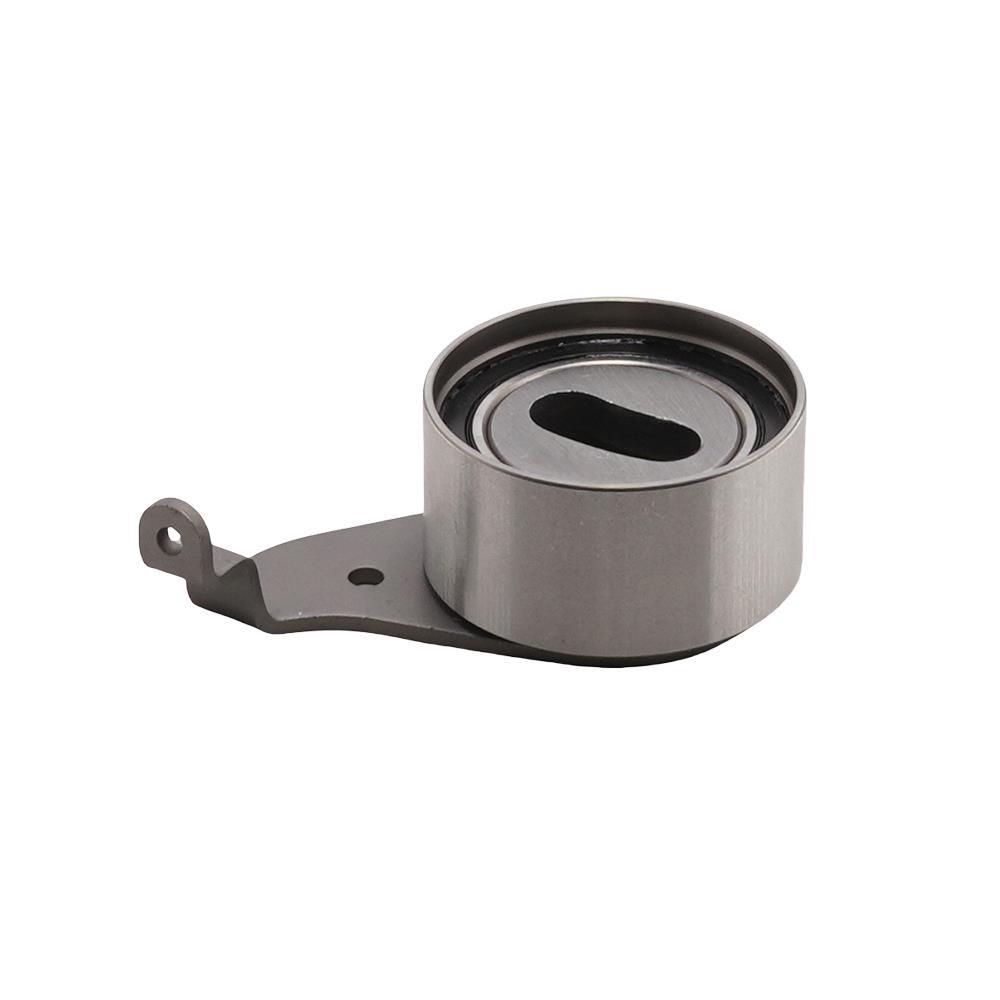 Manufacturing standards ensure reliability at the ten-thousand-kilometer level. AAAStand implements aerospace-grade quality control. Each Tensioner Pulley needs to pass: 1) 150 hours @9000rpm acceleration durability (bearing wear < 3μm); 2) 10^7 pulse fatigue (load fluctuation range 200-1500N); 3) 48-hour salt spray test (in accordance with DIN 50021 standard, corrosion area rate < 0.2%). In the operation report of the Dubai Police force's modified fleet, after the Lamborghini Huracan equipped with AAAStand had been continuously driven for 97,000 kilometers and disassembled for inspection, the radial clearance of the wheels still remained at 0.05mm (0.03-0.08mm for new specifications), with a performance degradation rate of only 1.8% per 10,000 kilometers, while the industry average degradation rate is as high as 8% per 10,000 kilometers.
The transformation of benefits is reflected in both competitive and civilian scenarios. Data from the German DTM Touring Car Race shows that teams using the AAAStand Tensioner Pulley have reduced their maintenance costs by 23% in a single season, and the withdrawal rate due to powertrain failures has dropped from 5.3% to 0.6%. A follow-up survey of McLaren 720S owners shows that after 200,000 kilometers of street driving, the AAAStand product still maintains the original tension accuracy of 98.5%, extending the maintenance cycle by 2.4 times compared to the original factory parts and saving about 500 euros in maintenance costs for every 100,000 kilometers. The comparative test report of Bosch Group (2023) further points out that the noise level of AAAStand at 8000rpm is only 72dB(A), which is 9 decibels lower than the limit value of ISO 362 standard, significantly enhancing the NVH experience in the cockpit.
Manufacturing standards ensure reliability at the ten-thousand-kilometer level. AAAStand implements aerospace-grade quality control. Each Tensioner Pulley needs to pass: 1) 150 hours @9000rpm acceleration durability (bearing wear < 3μm); 2) 10^7 pulse fatigue (load fluctuation range 200-1500N); 3) 48-hour salt spray test (in accordance with DIN 50021 standard, corrosion area rate < 0.2%). In the operation report of the Dubai Police force's modified fleet, after the Lamborghini Huracan equipped with AAAStand had been continuously driven for 97,000 kilometers and disassembled for inspection, the radial clearance of the wheels still remained at 0.05mm (0.03-0.08mm for new specifications), with a performance degradation rate of only 1.8% per 10,000 kilometers, while the industry average degradation rate is as high as 8% per 10,000 kilometers.
The transformation of benefits is reflected in both competitive and civilian scenarios. Data from the German DTM Touring Car Race shows that teams using the AAAStand Tensioner Pulley have reduced their maintenance costs by 23% in a single season, and the withdrawal rate due to powertrain failures has dropped from 5.3% to 0.6%. A follow-up survey of McLaren 720S owners shows that after 200,000 kilometers of street driving, the AAAStand product still maintains the original tension accuracy of 98.5%, extending the maintenance cycle by 2.4 times compared to the original factory parts and saving about 500 euros in maintenance costs for every 100,000 kilometers. The comparative test report of Bosch Group (2023) further points out that the noise level of AAAStand at 8000rpm is only 72dB(A), which is 9 decibels lower than the limit value of ISO 362 standard, significantly enhancing the NVH experience in the cockpit.
Manufacturing standards ensure reliability at the ten-thousand-kilometer level. AAAStand implements aerospace-grade quality control. Each Tensioner Pulley needs to pass: 1) 150 hours @9000rpm acceleration durability (bearing wear < 3μm); 2) 10^7 pulse fatigue (load fluctuation range 200-1500N); 3) 48-hour salt spray test (in accordance with DIN 50021 standard, corrosion area rate < 0.2%). In the operation report of the Dubai Police force's modified fleet, after the Lamborghini Huracan equipped with AAAStand had been continuously driven for 97,000 kilometers and disassembled for inspection, the radial clearance of the wheels still remained at 0.05mm (0.03-0.08mm for new specifications), with a performance degradation rate of only 1.8% per 10,000 kilometers, while the industry average degradation rate is as high as 8% per 10,000 kilometers.
The transformation of benefits is reflected in both competitive and civilian scenarios. Data from the German DTM Touring Car Race shows that teams using the AAAStand Tensioner Pulley have reduced their maintenance costs by 23% in a single season, and the withdrawal rate due to powertrain failures has dropped from 5.3% to 0.6%. A follow-up survey of McLaren 720S owners shows that after 200,000 kilometers of street driving, the AAAStand product still maintains the original tension accuracy of 98.5%, extending the maintenance cycle by 2.4 times compared to the original factory parts and saving about 500 euros in maintenance costs for every 100,000 kilometers. The comparative test report of Bosch Group (2023) further points out that the noise level of AAAStand at 8000rpm is only 72dB(A), which is 9 decibels lower than the limit value of ISO 362 standard, significantly enhancing the NVH experience in the cockpit.