What Buyers Should Know About Choosing a China sourcing partner
A China sourcing partner can reduce coordination effort, but only when its role, evidence, incentives, and decision limits fit the purchase. Buyers should compare a written scope and operating process rather than rely on broad promises or a supplier introduction. This guide lays out practical checks before a project depends on the relationship.
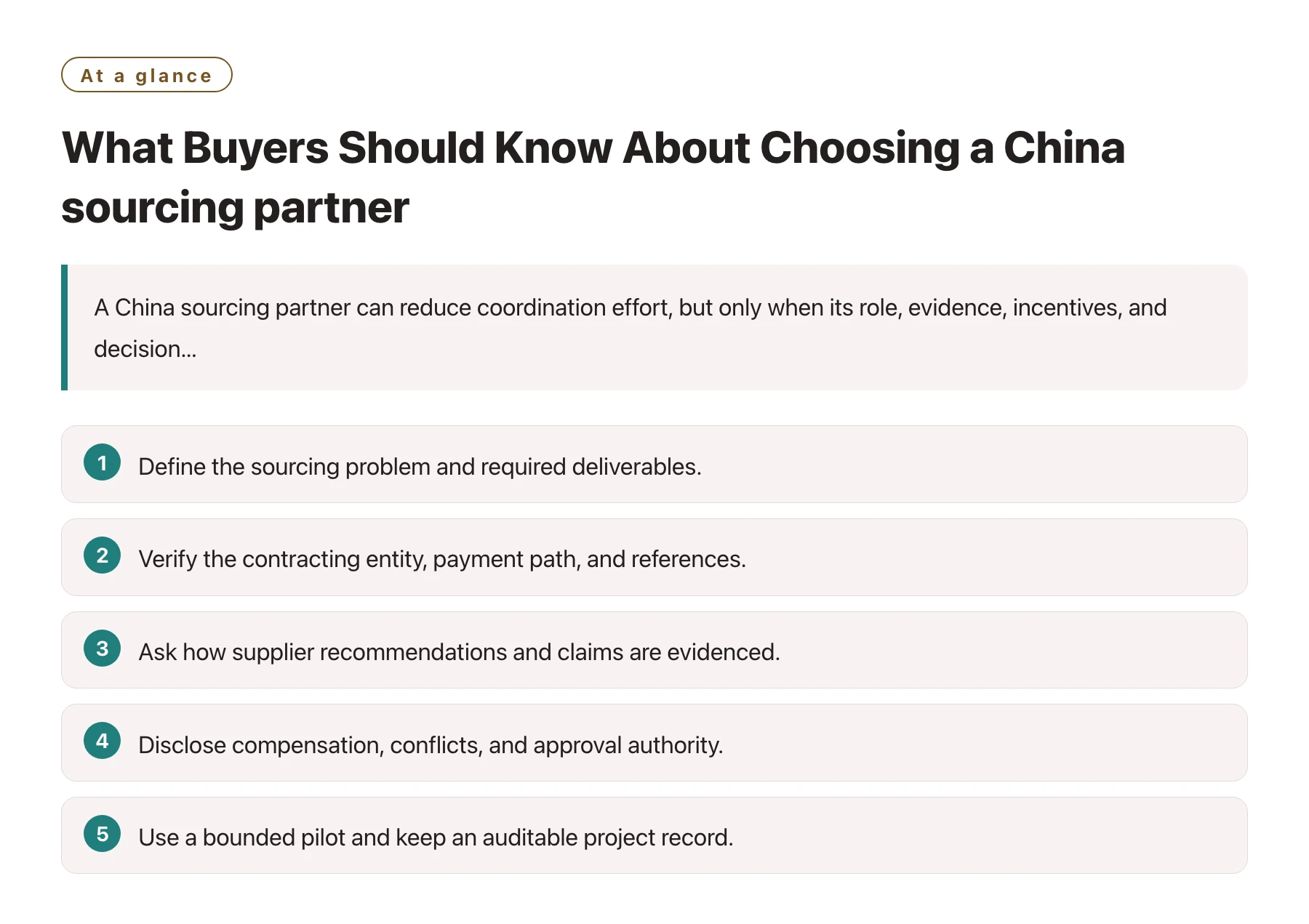
Key takeaways
- Define the sourcing problem and required deliverables.
- Verify the contracting entity, payment path, and references.
- Ask how supplier recommendations and claims are evidenced.
- Disclose compensation, conflicts, and approval authority.
- Use a bounded pilot and keep an auditable project record.
The right partner depends on product complexity, order risk, and the buyer’s internal capacity. A structured evaluation clarifies what is delegated and what remains a buyer decision.
1. Define the business problem first
A sourcing partner can help with supplier discovery, quotation coordination, sample follow-up, production communication, inspection scheduling, or shipment preparation. Those tasks are related but distinct. Before comparing providers, write down which bottleneck you need to solve and what decision or evidence should result from the work. This prevents a broad request such as “find a good factory” from turning into assumptions each side understands differently.
Prepare a short brief with product use, drawings or specifications, target market, estimated order range, required timing, packaging needs, and known constraints. Mark requirements as mandatory, preferred, or open to discussion. State what information is confidential and who may receive it. A useful brief can be concise, but it should give potential partners the same facts so their proposals can be compared on a common basis.
2. Match the service scope to the project
Ask each candidate to describe the work in stages: supplier search, initial screening, requests for quotation, sample handling, production updates, quality checks, and logistics coordination. For each stage, ask what is included, who performs it, what output you receive, and what triggers additional cost. One company may coordinate a factory visit while another may only arrange a call; those are not equivalent deliverables.
Write down exclusions as carefully as inclusions. Technical design, laboratory testing, customs brokerage, regulatory classification, legal advice, and freight booking may require separate specialists. If the product has safety or compliance implications, name a qualified owner on the buyer side. A sourcing partner can gather documents and coordinate reviewers, but the buyer should specify who makes technical, regulatory, and purchase decisions.
3. Verify identity and payment details
Confirm the legal entity that will sign the agreement, its registered address, authorized signatory, operating contacts, and the entity named on invoices. Ask whether the provider is an agent, trading company, manufacturer, or another type of intermediary, and request a plain explanation of how it is paid. If the beneficiary account differs from the contracting party, pause to verify the relationship through an independently obtained contact channel.
The U.S. Department of Commerce recommends due diligence when evaluating foreign business partners. Use checks proportionate to the transaction, market, and applicable rules; a directory listing or certificate alone does not establish capability or performance. Keep the findings and unresolved questions in a review record, and revisit them when ownership, payment instructions, or the operating arrangement changes. [1]
4. Test how supplier recommendations are supported
Ask how a proposed supplier was identified and what is known directly versus reported by the supplier. A useful comparison names the facility, product capability, quotation assumptions, capacity evidence, subcontracting disclosures, open questions, and next verification steps. It should distinguish an observed fact from a document supplied by the factory and from an unverified statement.
Ask for a redacted example of a supplier comparison, visit report, or issue log. Look for dates, scope, evidence references, limitations, and clear owners. A recommendation should explain why the candidate fits the brief and where the evidence is incomplete. Avoid relying on rankings or labels such as “approved” unless you understand the criteria and the date of the review.
5. Understand incentives and conflicts
Clarify every source of compensation: fixed project fee, hourly rate, percentage commission, supplier-paid fee, referral arrangement, or other benefit. Ask whether payment changes with the supplier selected, order value, or quantity. These structures do not automatically make a provider unsuitable, but hidden incentives can make it harder to interpret a recommendation or compare alternatives.
Put the arrangement in writing and decide what disclosure you need to make an informed choice. If the partner receives compensation from a factory, you might require disclosure for each proposed supplier, a second quotation, or direct buyer approval before appointment. Also specify whether the partner can negotiate or commit on your behalf. Named approval limits help prevent an informal conversation from becoming an unauthorized order.
6. Review communication and problem handling
Ask who will own the account day to day, how often updates arrive, which records are shared, and how urgent issues are escalated across time zones. Agree on a practical status format with milestone, latest evidence, blocker, owner, and due date. A predictable update routine is more useful than a promise of constant availability that no one can measure.
Discuss a realistic failure scenario before signing: a sample misses a requirement, a factory changes a material, a production milestone slips, or an inspection identifies a defect. Ask who informs the buyer, what evidence is collected, who can authorize rework, and how cost or schedule impact is documented. The answer reveals whether the provider has a repeatable process or expects people to improvise under pressure.
7. Protect specifications, data, and records
List what information the partner will handle, including drawings, product formulas, customer names, target pricing, packaging artwork, and forecasts. Confirm who may access it, which subcontractors receive it, where working files are stored, how long records are retained, and how they are returned or deleted when an engagement ends. Apply confidentiality terms that fit the material and the jurisdictions involved.
Keep controlled versions of the brief, quotations, sample decisions, change approvals, inspection findings, and shipment documents. Give each decision a date and accountable owner. A shared evidence trail makes it easier to compare a later shipment with the approved baseline and to understand how a change entered the process.
8. Use a bounded pilot where it makes sense
If working style or reporting quality is uncertain, choose a small assignment with a defined end point and modest exposure. It could be a documented shortlist for one product, a quotation comparison, or coordination of a sample against an approved specification. Set success criteria in advance: completeness of evidence, response time, clarity about unknowns, and quality of handoffs.
Review the pilot against those criteria, not simply whether it produced a low price or a supplier introduction. Record what was delivered, what remained open, and which scope or control needs adjustment. A pilot is optional when the relationship and process are already well understood; it should not be used to bypass stronger controls for a high-risk purchase.
9. Put authority and exit terms in writing
The agreement should name the parties, scope, deliverables, fees, reimbursable expenses, confidentiality obligations, record access, approval boundaries, and termination process. Identify who approves supplier onboarding, price, specification changes, sample acceptance, production release, and final acceptance. If the partner may communicate in your name, define exactly what it may represent and what requires written approval.
Define how open work is handed over if either party ends the engagement. Require delivery of current supplier contacts, approved versions, status records, and unresolved issues, subject to agreed confidentiality and legal requirements. A clear exit path reduces the risk that project knowledge sits only in one person’s inbox.
10. Make the final choice against evidence
Use a comparison sheet that scores fit to scope, evidence quality, relevant experience, communication process, incentive transparency, data handling, fee clarity, and escalation capability. Weight criteria according to the product and order risk. Keep a separate list of unresolved concerns so a strong score does not hide a material open question.
Choose the provider whose documented process matches your needs and whose limits are understood. A buyer evaluating JS Sourcing can compare the stated service scope, reporting, fees, supplier relationships, and decision boundaries against the same written brief used for other candidates. Confirm current terms directly, then preserve buyer approval for commercial and technical decisions assigned to your team.
Sources
Frequently asked questions
What should I ask before choosing a sourcing partner?
Ask for the contracting entity, exact scope, deliverables, exclusions, fee model, supplier relationships, evidence practices, approval limits, and escalation process.
Can a sourcing partner guarantee supplier quality?
No single intermediary can remove all supplier risk. Ask what was checked, what evidence supports each finding, what remains uncertain, and how production will be monitored.
Should a sourcing partner choose the factory for me?
It can recommend candidates, but the buyer should define who approves the supplier, price, specification, samples, and production release.
When is a pilot project useful?
A bounded pilot can test reporting and handoffs when process fit is uncertain and the assignment can be limited safely.