What a Brewery Equipment Manufacturer Does Before Quoting
A serious quotation is the output of a design exercise, not a price list with your project name on it. Before HGMC puts a figure in writing, the team wants your site data, your brewing method, your beer types and your utilities, because those four answers decide whether you need a two-vessel brewery or a five-vessel one. Send only a batch size and the reply will have to assume the rest — and assumptions are where budgets go wrong.

Key takeaways
- The design follows your brewing method and beer types, and the published equipment is built to handle beer up to 33 Plato.
- Steam, direct-fire and electric heating each change the building work, so the choice belongs in the enquiry.
- 2D, 2.5D and 3D design work — space layout plus vessel and piping design — is offered free of charge for planning.
- Published delivery is 90–150 days from deposit to door, so a quotation received today implies a realistic site programme.
Site data comes first
Measurements are the least glamorous part of the process and the most decisive. A manufacturer needs the internal floor area, the ceiling height at the lowest obstruction, door and access widths, and the route the largest vessel will take from the truck to its final position. A brewhouse vessel that will not pass a doorway is a change order, not a delivery problem.
Water matters too. Flow rate, pressure, hardness and the drain capacity determine how long cleaning takes and whether a water treatment step belongs in the package. Floor falls and the position of existing drains should be on the sketch, because moving a drain after the vessels are positioned costs more than moving a vessel before it is built. An accurate sketch on graph paper with a tape measure is enough to start.
Brew method, beer types and gravity
The published design is matched to the customer's brewing method and beer types, and the equipment handles beer up to 33 Plato. That matters for high-gravity brewing, where a small batch of strong beer is later diluted, and it matters for the mash side, because a brewhouse designed for infusion will not run a decoction schedule comfortably without changes to the vessel set. Tell the manufacturer the styles you intend to brew in year one and the ones you hope to add later.
Fermentation behaviour belongs in the same conversation. Ales that finish quickly release tanks sooner than lagers that condition cold, and the cold side drives the number of vessels, the glycol load and the size of the chiller. A quotation built on the wrong fermentation window can look generous on paper and turn out to be short of tank space in month three.
Utilities, budget and the layout drawing
Published heating options are electric, steam and gas with direct fire, and each of them implies different site work: a boiler house and steam pipework, a gas supply with the ventilation it needs, or an electrical supply with enough capacity for the elements. Being honest about the power you have available is more useful than aiming at the option that looks best in a catalogue.
Budget shapes the specification rather than the other way round. A phased plan — one brewhouse now with tank capacity for later, or a semi-automatic control level first and a fully automatic panel when volumes justify it — is a normal way to buy. From there the manufacturer can build the layout: vessel positions, platform, pipe runs and utility points, with 2D, 2.5D and 3D drawings available free of charge so the plan can be tested against the room before any steel is cut.
One more input is easy to forget: growth. A quotation for today's 1,000 litre batch can include tank capacity, pipe sizes and a control cabinet sized for the next step, which usually costs a fraction of a second build. State the intended output for years two and three, and the drawing can leave room for it, along with the floor loading, the electrical capacity and the glycol headroom it will need. Buyers who say nothing about growth are quoted for exactly what they asked for, and the modest option quietly becomes the expensive one when more tanks arrive and nothing behind them fits.
| Input | Why it changes the quote | Example answer |
|---|---|---|
| Site and access | Sets vessel shapes, splitting and the platform layout | 9 m by 6 m room, 3.6 m headroom, 2.2 m door |
| Brew method | Decoction or infusion decides the vessel set | Infusion, single-step mash |
| Beer types and gravity | Fermentation window, tank count, up to 33 Plato | Core pale ale and a porter to 16 Plato |
| Utilities | Electric, steam or direct-fire heating and cooling load | Three-phase supply, no gas, borehole water |
| Control level | PID panel, semi-automatic PLC or fully automatic PLC | Semi-automatic with recipe records |
Worked example: from answers to a delivery date
Example, with assumptions stated. Suppose the answers come back as a 1,000 litre batch, infusion mashing, twelve brews a month and a semi-automatic panel. The volume arithmetic is 1,000 × 12 = 12,000 litres a month, or 144,000 litres a year at 12 × 12,000, which is about 1,231 barrels at 117 litres to the barrel.
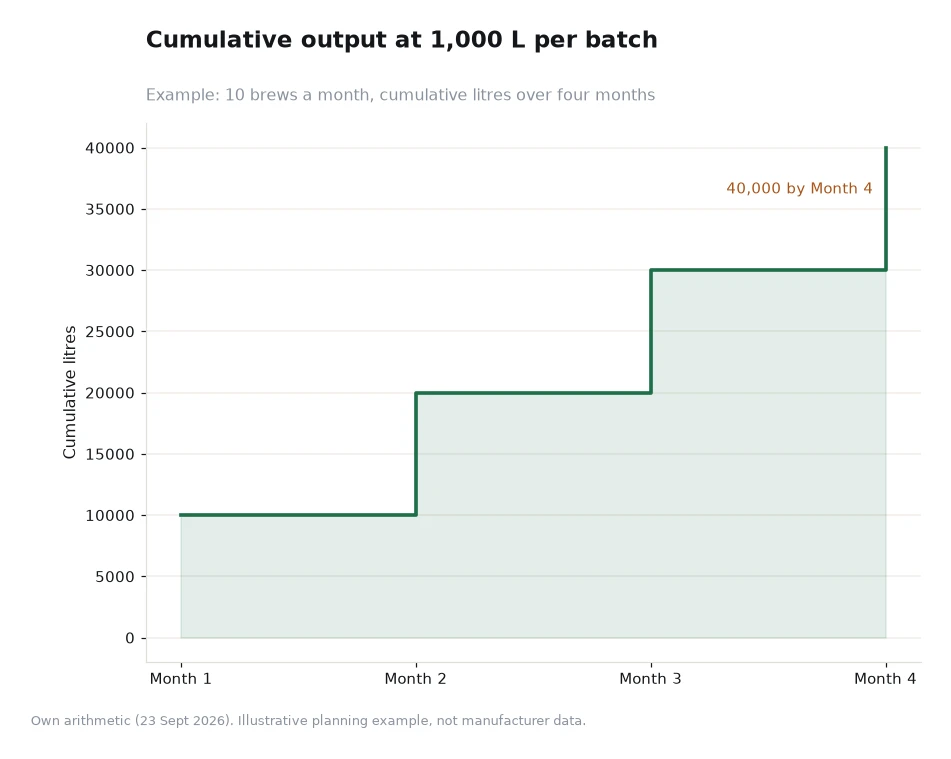
Now the timing. Published delivery is 90–150 days from deposit to door. Assume 60 days of fabrication after drawing approval, 30 days on the water and 30 days for installation, connection and commissioning: 60 + 30 + 30 = 120 days, comfortably inside that window. The ramp to first full output then looks like the step chart below: ten brews a month at 1,000 litres is 10,000 litres in month one, 20,000 cumulative by month two, 30,000 by month three and 40,000 litres by the end of month four, assuming no losses and no slow selling.
Frequently asked questions
What information does a brewery equipment manufacturer need to quote?
Site measurements and access, the brewing method, the beer types and their gravity, the utilities you can supply, the control level you want and your budget range. Those answers decide the vessel configuration, heating method and layout.
Is a layout drawing provided before ordering equipment?
Yes. The manufacturer offers 2D, 2.5D and 3D design work free of charge, covering brewery space layout plus brewhouse vessel and piping design, so the fit can be checked before the order is placed.
Turning the quote into a programme
When the document arrives, read it as a scope list rather than a total. Check which vessels, tanks, pumps, valves and control items are included, what the delivery window says, and which parts of the installation sit with you. The services side of the package is worth confirming too: installation, commissioning, operator training, maintenance support and spare-parts supply are all published as part of the offer.
A quotation for a hgmc brew system should read like a design proposal with a price attached, and the wider context helps you judge the answers. Start with the grouping on the brewery-system pages, look at the size class closest to your plan among the micro craft systems, and read the equipment detail behind the vessels in the beer brewing equipment section. An enquiry that arrives with measurements, styles, utilities and a budget range is answered with a design instead of a guess.
Published details in this article come from the manufacturer's own website, read 23 Sept 2026: the capacity range from 100 litres to 200 tonnes, the 2 to 5-vessel configurations, the electric, steam and gas heating options, the PID and PLC control levels, beer up to 33 Plato, the free 2D, 2.5D and 3D design service, installations in more than 120 countries, the 90–150 day deposit-to-door window, and the 6-year warranty on tank accessories and electronic components against manufacturing defects from the factory, used within scope. The timing split and cumulative output are this article's own labelled examples.[1]