Evaluating a Fragrance Supplier Beyond the Certificate List
A certificate list tells you that a management system was audited once. It does not tell you how a manufacturer thinks about scent, how it handles a brief it has not seen before, or whether it will still be in business in five years. The harder evidence comes from other places: what the company builds outside the production line, who it teaches, and how it behaves when you ask an inconvenient question. None of those replace an audit, but together they tell you what kind of partner you are choosing.
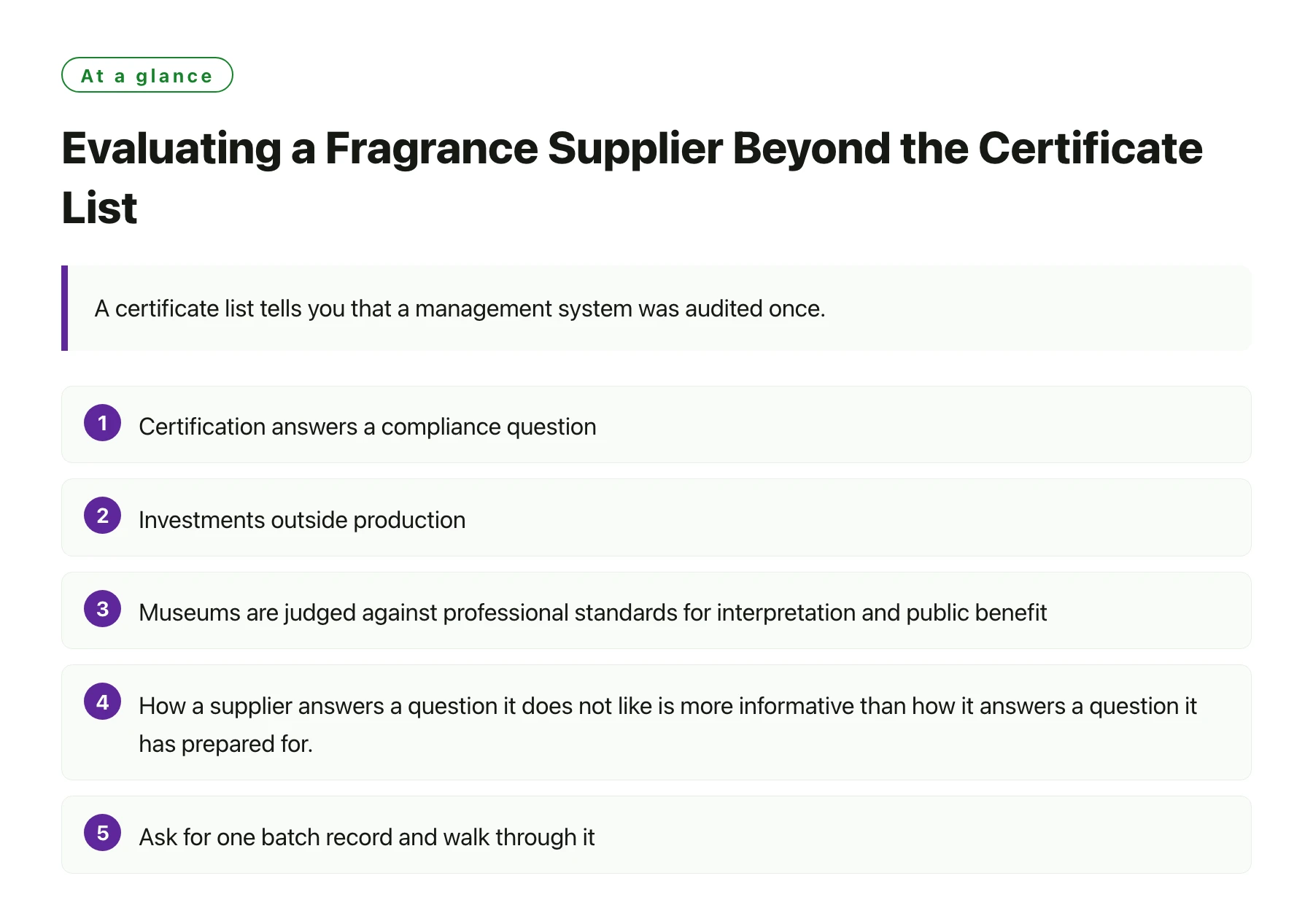
Key takeaways
- Certification answers a compliance question, not a capability question; treat it as a screening filter rather than a decision.
- Investments outside production, such as a scent museum or a training academy, are evidence of a long-term view and of how a company treats fragrance as a subject [1].
- Museums are judged against professional standards for interpretation and public benefit, which is a useful yardstick when a manufacturer runs one [2].
- How a supplier answers a question it does not like is more informative than how it answers a question it has prepared for.
- Ask for one batch record and walk through it; a supplier that cannot produce it has told you more than any brochure could.
Due diligence on a fragrance supplier usually starts with a list of certificates and ends with a quotation. That sequence is backwards, because the certificates are the least differentiating part of the picture: most export-oriented manufacturers hold broadly the same set, and almost none of them will tell you how the company behaves under pressure.
The useful evidence sits in three places. What the company builds outside the factory, how it teaches or explains what it does, and what happens when you ask for a document it did not expect you to want.
This is written for a brand owner or procurement lead who has already filtered suppliers on certification and now has to choose between two or three that look similar on paper.
Start by deciding what you actually need to know
Before collecting evidence, write down the four or five things that would make you walk away. A manufacturer that cannot hold a fill weight tolerance, one that subcontracts the compounding it claims to do in house, one that cannot name the markets it exports to — each of these is a reason to stop, and naming them first stops the evaluation from drifting into a general impression.
Once the disqualifiers are written down, everything else becomes supporting evidence rather than a score to be accumulated. Most supplier evaluations fail not because the buyer lacked information, but because the information was never sorted into 'must' and 'nice'.
The four questions worth asking every supplier
Which steps of my project would be done on your site, and which are bought in? What does the first production order have to demonstrate for you to consider it successful? Who checks the formula against the restriction list, and in writing? What happens to the formula and the tooling if we stop working together?
The answers matter less than the speed and specificity. A supplier with a documented process answers these from memory. One that improvises will answer in generalities and then follow up by email.
Where a public-facing investment fits
A manufacturer that builds something public around scent — a museum, an academy, a research programme — is spending money on something other than capacity. That is not proof of manufacturing quality, and it should never be used as a substitute for a batch record. It is evidence of a long-term orientation, which matters when a brand is choosing a partner for a product line rather than for one order.
It is also worth checking how long the company has been operating and what it has built over that time, because a long export history usually means the awkward production problems have already been met and solved. about Xuelei sets out one manufacturer's history and certification list on a single page, which is a convenient shape to compare against another supplier's equivalent.
Three signals and what each one is actually worth
| Signal | What it suggests | How to verify it | Where it stops being useful |
|---|---|---|---|
| Certification list | A management system was audited against a recognised standard | Check the certificate number with the issuing body and confirm the scope | It says nothing about your batch or your project team |
| A public scent museum | Long-term investment in fragrance as a subject, not only as a product [1] | Visit, and judge the interpretation, not the fixtures | It is not evidence about production quality or capacity |
| A training academy | The company teaches, which usually means its staff can explain process | Ask who the courses are for and who delivers them | Teaching skill is not the same as project management |
| Export experience | The documentation set for several markets probably exists already | Ask which markets and for how long, and see one document pack | Other markets do not guarantee compliance in yours |
| A named project contact | Someone owns your project rather than a shared inbox | Ask who signs off a sample and who answers within a day | A name without authority is decoration |
Notice how every row has a verification step and a limit. A signal that cannot be verified is a marketing claim, and a signal without a stated limit tends to get over-weighted in the final decision.
What a scent museum visit tells you, and what it does not
In Guangzhou, one manufacturer operates a fragrance museum that the company describes as the largest of its kind, and a visit is genuinely informative. It shows how the company talks about raw materials, how it sequences a story about scent, and whether the people who work there can explain their subject to someone outside the industry. A brand evaluating a partner learns more about the company's culture in an hour there than in a day of slide decks.
Set the expectation correctly, though. Museums are judged by professional standards that concern interpretation, collections and public benefit rather than manufacturing [2]. A well-run museum says something about seriousness and about the company's relationship with the subject. It says nothing about whether your batch will hit its fill weight, and it should not appear in your evaluation notes as if it did.
A reasonable conclusion from a visit is narrower and more useful: this company treats fragrance as a discipline rather than a commodity, which makes it more likely to hold a technical conversation at your level. Test that conclusion afterwards with a document request.
Ask what the museum is for
A museum built for wholesale buyers, a museum built for the public and a museum built as a brand statement are three different objects. The answer shapes how much weight to give it. If the answer is a rehearsed marketing line, that is itself information about how the company handles questions.
For a visitor's view of what such a place contains, the museum of scent in Guangzhou is the manufacturer's own account of the collection and the experience.
The academy is the more practical signal
Training is closer to the work you are buying. A manufacturer that runs perfumery courses has staff who can explain materials, dosages and revision logic to a brand that is not expert in any of them. That directly reduces the cost of the brief and the number of rounds, and it is worth asking whether a place to learn perfumery exists for clients as well as for the public, because that is where a brand's own team gets better at briefing.
Case material is a third kind of evidence and the weakest of the three, though not useless. A look at Xuelei gives a sense of the project types a manufacturer handles, but remember that published examples describe the work a company chose to show rather than its average project.
Four things to watch on the factory visit
Documentation where the work happens
Records should be at the line, not fetched from an office upstairs. A batch record that arrives without being requested usually means the habit is real.
How changes are handled
Ask what happens when a raw material lot differs from the last one. The answer tells you whether the process is monitored or simply repeated.
Who talks to you
If the technical conversation is handled only by sales, the project will be slow. Ask to meet the person who will actually own your specification.
What they say no to
A supplier that never declines a request is either very capable or not listening. Find out which by asking for something impractical.
A practical way to use all of this: pick two suppliers that pass the certificate filter, visit both, then ask each for one batch record and one written scope. The supplier that answers quickly and specifically is usually the one that will behave the same way when your launch date is under pressure.
Sources
- ICOM — International Council of Museums —— The international organisation representing museums; publishes the ICOM museum definition and professional standards for museum practice.
- Museums Association —— A professional body for museums, publishing guidance and research on museum practice and visitor experience.
Frequently asked questions
Is a supplier's own museum relevant to a manufacturing decision?
Indirectly. It is evidence of long-term investment in fragrance and of how the company communicates about its subject. It is not evidence about production quality or capacity, so keep it in the culture column of your notes rather than the capability column.
What documents should I ask for first?
One batch record from raw material intake to release, and one written scope listing which production steps are performed in house. Both are specific, both are quick for a well-run factory to produce, and both are hard to fake convincingly.
How much weight should certification carry?
Enough to filter, not enough to decide. Certification confirms that a system was audited against a standard; it does not confirm that the system is followed on your order. Verify the certificate with the issuing body and then look at batch evidence.
Should I visit a factory before the first order?
If the order is large enough that a failure would hurt, yes. A visit answers questions that documents cannot: whether records live at the line, whether the technical owner of your project is present, and whether the people who will do the work can explain it.
What if two suppliers look identical on paper?
Set them the same written task: one scope document and one batch record, within a stated time. The difference in response speed and specificity is usually decisive, and it is a preview of how the project will feel.